In the field of industrial
production, it is the three-phase AC motor that plays a leading role, providing
a continuous and powerful driving force for the production process.In
the realm of industrial production, the three-phase AC motor takes center
stage, providing a continuous and robust driving force for the production
processes.In the realm of industrial production, the star
performer is the three-phase AC motor, which supplies a steady and powerful
driving force for the production processes.In the field of industrial
production, the leading role is played by the three-phase AC motor, which
provides a continuous and powerful driving force for the production process.
Using a frequency converter
to control a motor primarily leverages its speed regulation capabilities to
achieve the following: ① Energy-saving
operation: When operating below 50Hz, the operating voltage (and current)
decreases, reducing power consumption and achieving significant energy savings. ② Excellent soft-start performance: By
reducing voltage and frequency, it can limit the maximum starting current to
within the rated current. Frequency converters are
classified into three major series: specialized for fans/pumps (P-type),
general-purpose (G-type), and vector control (high-torque type). · Specialized
frequency converter: Suitable for loads with quadratic torque reduction, with
slightly lower overload resistance. · General-purpose
frequency converter: Suitable for constant torque loads, with stronger overload
resistance. · Vector control
frequency converter: Has strong load adaptability, enabling AC motors to
achieve driving effects similar to those of DC motors. From a maintenance
perspective, the hardware circuit structure of the control circuit is actually
the same for all three models, with the only differences lying in the software
control and overload capacity. For the latter two models, the power output module
(inverter module) selected is one power level higher. For example, a 5.5KW
general-purpose model is actually equivalent to a 7.5KW specialized model for
fans/pumps. Basic
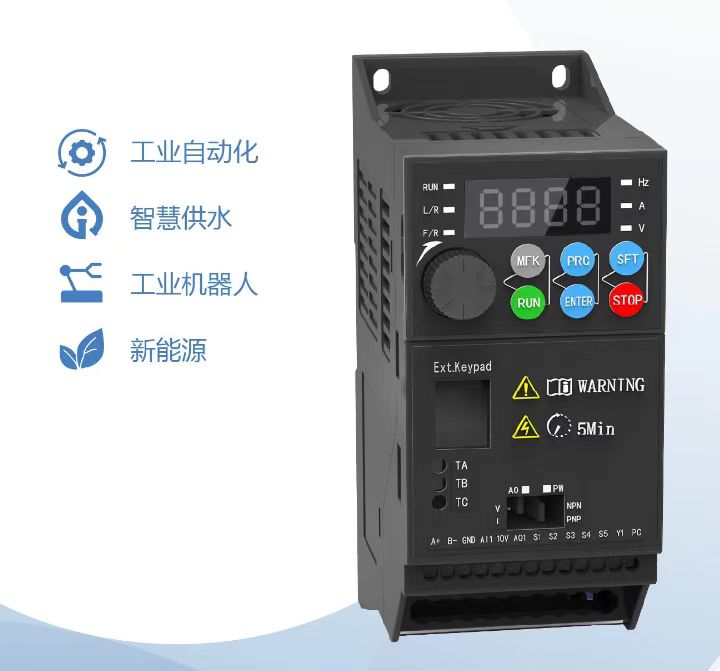
Application of Frequency Converter: The JienluAGD310 series vector control frequency converter features high-precision andhighly intelligent control functions. The wiring is as follows: Main terminal
wiring includes three-phase power input terminals, inverter voltage output
terminals, externally (or internally) connected DC reactor terminals, brake
unit connection terminals, etc. According to electrical standards, the
three-phase power terminals are labeled as L1, L2, and L3, while the
three-phase power input terminals of the frequency converter are labeled as R,
S, and T; the output terminals of the frequency converter are labeled as U, V,
and W. 1.Points for attention in main terminal wiring: 2.If the power input and output are connected incorrectly, and
three-phase AC380V is mistakenly connected to the U, V, and W terminals, the
"equivalent three-phase rectifier bridge" circuit formed by the
parallel diodes inside the IGBT devices will create an unlimited charging
current for the DC circuit's energy storage capacitor, which is highly likely
to damage the internal inverter power module and energy storage capacitor. 3.During commissioning or maintenance, the terminal should be
short-circuited to provide the internal working power supply for the machine. 4.Small power frequency converters below 11KW usually contain
braking switching tubes and power braking resistors internally. For large and
medium-sized power frequency converters, terminals are often led out from the
DC circuit for external connection to braking units. Some small models contain
braking switching tubes with terminals led out for external connection to
braking resistors.
The role of control terminals: The
control terminals of a frequency converter generally include digital signal
input terminals, analog signal input terminals, digital signal output
terminals, and analog signal output terminals, with the first three being more
commonly used. The digital signal control terminals are for switching signal
inputs, and external signal input devices can be switches, buttons, or contact
signals from output relays, etc., used for controlling the start, stop, fault
reset, and multi-speed operation of the frequency converter. External control
components are connected to a 24V auxiliary power supply via the terminals to
form a control command input circuit, which inputs signals into the internal
circuit of the frequency converter. These control signals are also known as the
control command sources of the frequency converter, determining its operating
state. Analog signal
input terminals typically include 0~10V voltage signal input terminals and
0/4~20mA current signal input terminals. Which control signal is active can be
set by parameters, and they can also simultaneously provide speed setpoints and
related feedback signals for implementing PID closed-loop control. The 10V
auxiliary power supply output from the terminals can be used to power external
potentiometers, forming a frequency adjustment signal. Analog input signals are
also known as the frequency command sources of the frequency converter,
determining its output frequency. Digital signal
and analog signal output terminals indicate the operating state of the
frequency converter through the contact status of the output signals. Most of
these are programmable output signals, and the internal output signals can be
set by parameters to supply external signal indicator lights, external
frequency counters, or voltmeters to display the operating frequency, output
voltage, and operating/stop/fault status of the frequency converter. The frequency converter also has a signal
terminal, which is the 485 communication terminal. The signal flow of this
terminal is bidirectional and does not distinguish between input or output
ports.
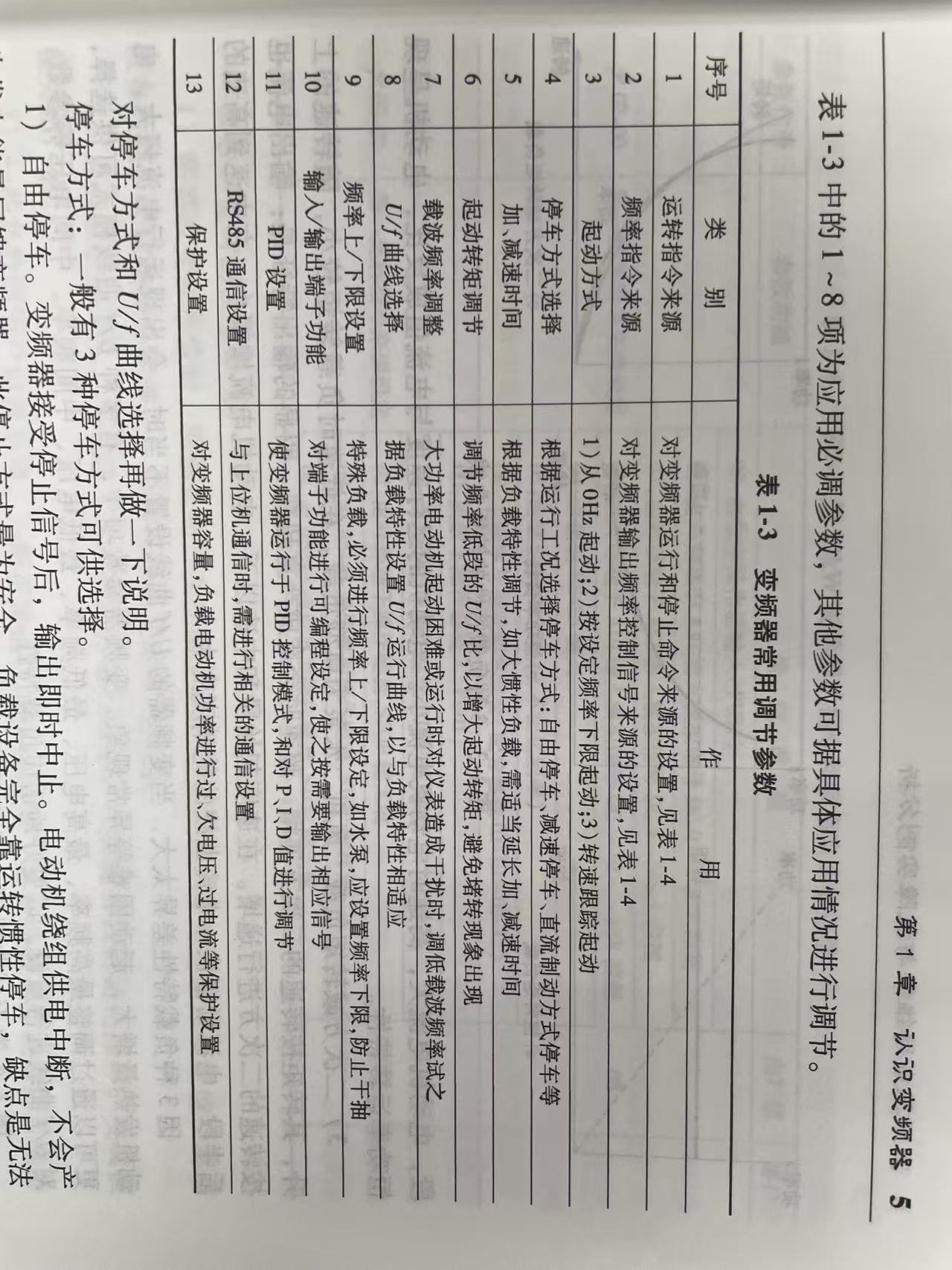
Control Parameters of the Frequency Converter: The basic control of a
frequency converter includes starting, stopping, and speed regulation. Apart
from using control terminals for control, the start/stop and speed regulation
can also be controlled via the operation and display panel. Additionally, whether
the frequency converter receives control from the operation panel or the
control terminals, whether the frequency command is received as a voltage or
current signal, or as a digital adjustment from the panel, and the operational
functions of the control terminals, all need to be preset through working
parameters. Parking Methods: (1) Free Parking: This parking method
is the safest, but the disadvantage is that it cannot precisely control the
parking time and position. (2) Deceleration Parking: After
receiving the stop signal, the frequency converter gradually reduces the
operating frequency until it stops. This parking method can effectively reduce
the "water hammer effect" in water supply control and mitigate the
impact on the pipeline system. The disadvantage of deceleration parking is that
when the motor overspeeds (due to a large system inertia), it generates
regenerative energy that feeds back into the DC circuit of the frequency
converter, requiring the installation of a braking unit and braking resistor to
eliminate this harmful energy. (3) DC Braking Parking: This method
allows for more precise control of parking time and position. The
purpose of setting and adjusting the U/f curve is to make the U/f output
characteristic of the frequency converter match the torque characteristic of
the driven load, in order to achieve smooth starting, reduce operating current,
and avoid phenomena such as stalling, ensuring scientific, reasonable, and
efficient operation. According to the torque characteristics of the motor load,
it can be divided into constant torque loads, constant power loads, and
quadratic torque-reducing loads.
If
you have a need to purchase a frequency converter, please contact Shanghai
Jienlu Electronics customer service via WhatAPP (WeChat ID): 15001775783